bitcoin romania

informati bitcoin

bitcoin sfaturi

stiri bitcoin

Translate

sâmbătă, 17 septembrie 2016

Bio-Implantable Bitcoin Wallets Becoming a Popular Storage Solution


Making a bitcoin payment with a body part may not be too unusual in the future
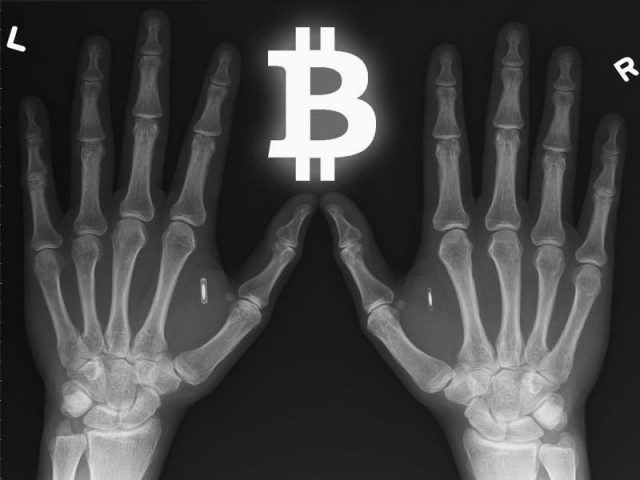
At this year’s Black Sea Summit in Kiev, an NFC, bio-implantable chip was demonstrated to attendees. The presentation of the Dangerous things xNT Implant showed how the product can store bitcoin keys and credit card data.

Dangerous Things xNT Implant 

When implanted under a person’s skin, the chip can facilitate a number of NFC financial transactions, including bitcoin payments.
The company has started an Indiegogo campaign to fund their project. So far, the team has raised over $30,000 USD, breaking their targeted goal of $8,000.
At a price of $99, the bio-chip comes contained in a cylindrical biocompatible glass — stored in a syringe ready for injection. Developers claim the xNT Implant is the first NFC-compliant, implantable RFID tag on the market. When a user wants to pay for an item, they scan the body part holding the device over any NFC-enabled point-of-sale application.
The xNT tag comes with its own beta Android app that features upcoming releases to the platform. The bio-chip assembly kit is EO gas-sterilized, and ships with an installation guide to help local body piercing professionals or medical practitioners inject the device.
The Seattle-based founders of Dangerous Things, Amal Graafstra and Dana Burnidge, are cyborg fans, and hope bio-hacking becomes mainstream in the near future.

Bitcoin-Based, Bio-Implantable Chips Have Been Around for a While

Over the past couple of years, several Bitcoin supporters have demonstrated bio-chip proof-of-concepts loaded with cryptocurrency.
For instance, back in June, a news report detailed the story of Meow-Ludo, founder of Biofoundry. Meow-Ludo integrated bitcoin keys and credit card information into an NFC chip implanted in his thumb, which held 868 bytes of data.
In 2014, Dutch entrepreneur Martijn Wismeijer made headlines after he implanted two bitcoin wallets in each of his hands. The NFC Type 2 compliant chipsets contained 880 bytes of data. Wismeijer told press that one hand was for cold storage, the other a hot wallet for purchases.

miercuri, 14 septembrie 2016

Romania’s BTCXChange Discontinues Bitcoin Exchange Service

Ever since relaunching the platform since August of 2015, things have been rocky, to say the least. For now, it remains unclear if there was a lack of volume, or a lack of investment to keep operations going.


Running Bitcoin exchanges requires a lot of time, effort, and money. But despite a lot of hard work, regulatory issues can always force a shutdown. Romania’s BTCXChange has shut down its services for good. Users had until yesterday to withdraw all of their funds. It is the second time BTCXChange is shut down, albeit it remains to be seen if they will return.
The announcement about BTCXchange shutting down was posted on the website in August of 2016. Users were advised to move all of their funds off the platform by September 12. Horeo Oradea Vuşcan, the owner of BTCXchange, has taken the decision to shut down the platform the second time.

Game Over for BTCXchange

To be more precise, he is looking for a new buyer to take over the domain and exchange platform. For now, it remains unclear as to why this decision was taken. We do know Vuşcan had plans to sell the company quite some time ago. Until a  buyer was found, he kept the platform up and running, until very recently.
The platform was initially launched in December of 2014 and shut down for the time one year later. The reason for that decision was due to a disagreement between the CEO and its main programmer. Some people may remember how this caused Vuşcan to rebuild BTCXChange from the ground up, which took nearly eight months to complete.
Ever since relaunching the platform since August of 2015, things have been rocky, to say the least. For now, it remains unclear if there was a lack of volume or a lack of investment to keep operations going. The sale of this platform will not be easy either, as its colorful history may not attract any serious offers.
One topic of consideration ish own Bitcoin is still not regulated in Romania. Although this doesn’t mean cryptocurrency is not allowed the country, it makes Bitcoin less appealing. While Vuşcan is still positive about the future of Bitcoin, he is not eager to handle all of the responsibility that comes with running an exchange.

miercuri, 7 septembrie 2016

Bitcoin Thrives In Countries Focusing On Financial Inclusion Efforts

It is not surprising most of the countries seeing success in the financial inclusion department are busy areas for Bitcoin as well.

Financial inclusion is not a topic most developing countries in the world can deal with right now. In some regions, very few people have convenient access to a bank account. However, thanks to the boom in mobile smart devices, financial inclusion becomes easier to achieve. In fact, the countries focusing on these efforts are also seeing a significant Bitcoin growth as of late.

Financial Inclusion Matters To Many Countries

According to the statistics outlined on The Finanser, quite a few developing countries are scoring well on the financial inclusion front. While there is still a lot of work to be done, things are looking healthy in most regions. Egypt is the only “major” developing country where difficult regulation and less mobile capacity are hindering growth right now.
At the top of the list is Kenya, a country where Bitcoin and mobile payments are thriving. With a high level of mobile capacity and an easy-going regulatory landscape, financial inclusion is on the rise. A score of 84% is quite good, albeit there is still work to be done. Colombia and Brazil complete the three, although adoption of new financial technologies is relatively low in those regions.
As is to be expected, regulation has somewhat of an effect on financial inclusion. To put things into perspective, a difficult regulatory landscape can still yield high rates of adoption, such as the Dominican Republic. Easy-going regulators are no guarantee for success, though. The Philippines has one of the “best’ regulatory frameworks for financial inclusion, yet only 42% adoption rate of new technologies.
It is good to see so many countries being fully committed to financial inclusion. Uganda, India, Pakistan, and Peru are just a few of the regions dedicating a lot of effort to this initiative. For now, several countries are held back due to their mobile capacity. Egypt, Ethiopia, and Peru still have their work cut out for them in this department.

Bitcoin Thrives In The Same Regions

However, it is important to keep in mind financial inclusion comes in different forms. Having access to a bank account, or mobile financial services, is just one option. Bitcoin, while still a niche market according to most, provides financial inclusion as well. Granted, it has no ties with the traditional financial infrastructure, but that is one of its strong suits. Being able to send and receive money, without having to visit physical locations, is important to a lot of people. Bitcoin provides that option to anyone who wants to take it.
It is not surprising most of the countries seeing success in the financial inclusion department are busy areas for Bitcoin as well. Diversification is important during these uncertain economic times. Putting all one’s eggs in the same basket is not a wise strategy. That goes for developed and developing countries alike.